

Directional boring for sewer lines
A new line, threaded under the yard instead of through it.
Get a fast quote
Tell us what's backing up. We answer fast — a real person, not a call center.
The plain version
What directional boring for sewer lines is
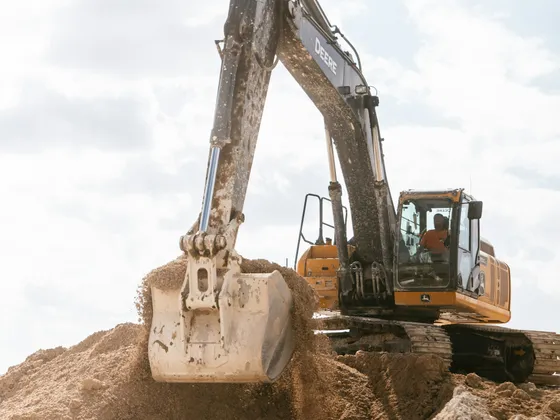
Directional boring installs a new sewer line without trenching between its ends. A steerable drill head is launched from a small pit, guided underground along a planned path to a receiving pit, and then the new pipe is pulled back through the bore. What sits above the path — driveway, patio, mature trees, the lawn you just re-sodded — is never opened.
Boring is the second of our two no-dig methods, and the division of labor between them is simple. Lining renews the pipe you already have and needs that pipe to still hold its shape. Boring does not care about the old pipe at all: it puts a new line in the ground on a path we choose. When a sewer has collapsed, lost its grade, or is made of something that cannot be lined, boring is how you get a new line without losing the surface.
It is also the capability most residential plumbers do not have, which is why failed lines under hardscape so often come with a quote for breaking concrete.
When you need it
Any one of these is reason enough to have the line looked at.
- The line has collapsed or deformed, so there is nothing sound left to line
- The run passes under a driveway, patio, or mature trees you will not sacrifice
- Grade is the underlying problem and the line needs re-laying, not renewing
- A quote you have already received involves cutting hardscape end to end
- The existing pipe is a material that cannot be reliably lined
On the day
How the job runs
Survey and plan the path
Existing utilities are located and the bore path is planned around them with the correct fall designed in from the start — grade is engineered here, not inherited.
Set the pits
A launch pit and a receiving pit are excavated at the two ends. These are the only openings the job makes.
Drill and steer
The bore head is tracked and steered underground along the planned line, with its position and depth monitored the whole way.
Pull the pipe and connect
New pipe is drawn back through the bore, tied in at both ends, camera-verified end to end, and the two pits are closed and restored.
Money, plainly
What it costs
Boring is priced by the length and depth of the bore, the soil it has to pass through, and the two connections at its ends. Sandy and consistent ground bores predictably; cobble, rock, or a path crowded with existing utilities takes longer and costs accordingly.
Compare it against an open-cut quote on total cost rather than line item. A trench across a driveway is not just the trench — it is the concrete, the base, the finish work, and the weeks of a torn-up approach. Boring often loses on the pipe line and wins decisively on the restoration line.
Why Rooter-X for this
Owning the equipment is the whole point: a plumber without boring capability can only offer you the trench, and the recommendation follows the tool.
Because the bore path is designed rather than inherited, we set the fall the new line will have for its entire life instead of reproducing whatever sag the old one developed.
Asked constantly
Questions we hear
How is boring different from epoxy lining?
Lining rebuilds the inside of your existing pipe and depends on that pipe still holding its shape. Boring ignores the old pipe entirely and installs a new line along a freshly drilled path. Lining is usually the lighter-touch option when it qualifies; boring is what remains when the host pipe is collapsed, deformed, or badly back-pitched. We run both, so the footage picks.
Will my driveway or patio survive?
That is the reason to bore. The drilling happens underground between two pits, so surfaces along the path are not opened. The pits themselves need working room at each end of the run, and if either one lands in a paved area you will see exactly where in the written scope before anything is cut.
Can you bore around tree roots and existing utilities?
Steering is the whole advantage of directional boring — the head can be guided around obstacles rather than through them, which is how a new line gets past a mature root ball that an open trench would have to cut. Everything known gets located first and the path is planned around it.
What if you hit something unexpected underground?
The head is tracked continuously, so an unexpected obstruction shows up as resistance and a position reading rather than as damage. The usual response is to retract and re-steer along a corrected path. Old, undocumented pipes and footings are the common surprises in mid-century neighborhoods, which is why locating before drilling is not optional.
Does the new bored line need permits and inspection?
Yes — installing a new sewer line is permitted work in Orange County cities, and the connection at the property line is typically inspected. We pull the permit, schedule the inspection, and meet the inspector as part of the job. That sign-off is an independent check on grade and materials before anything is buried.
Related services
Talk to us about boring.
A real person answers, and the first step is always looking, not selling.